On a ship, the bell wasn't decoration. For centuries it was the clock, the alarm and the call to work, and it rang to a pattern that sounds strange to landlubbers: never more than eight strokes, whatever the time. With New Year's Eve coming, here's how it worked, and why some ships ring sixteen at midnight.
The watch system
A ship at sea never sleeps, so the crew worked in shifts called watches. The Mary Rose Trust explains that a four-hour watch was the standard shift on board. Royal Museums Greenwich, describing life aboard the Cutty Sark, says the crew was split into two watches, "port" and "starboard", which took turns so that one watch was always on deck.
Counting the half hours
The bell marked time within each watch, not the hour of the day. According to the Mary Rose Trust and Royal Museums Greenwich:
- one stroke was added every half hour;
- after four hours there were eight strokes, and the watch changed;
- then the count started again at one.
The National Museum of the Royal New Zealand Navy notes that the strokes are rung in pairs. So 0800 is eight bells, 0830 is one bell, 0900 is two bells, and so on up to eight bells again at noon. Half past three in the afternoon is seven bells.
On the Mary Rose, the half hours were measured with sand-glasses. The Mary Rose Trust says four sand-glasses were recovered from the wreck of Henry VIII's warship, two of them near where the bell had hung.
The dog watches
There's one odd one out. The Royal New Zealand Navy museum explains that the evening is split into two shorter dog watches, 1600 to 1800 and 1800 to 2000, as exceptions to the four-hour pattern.
Fog, emergencies and all hands
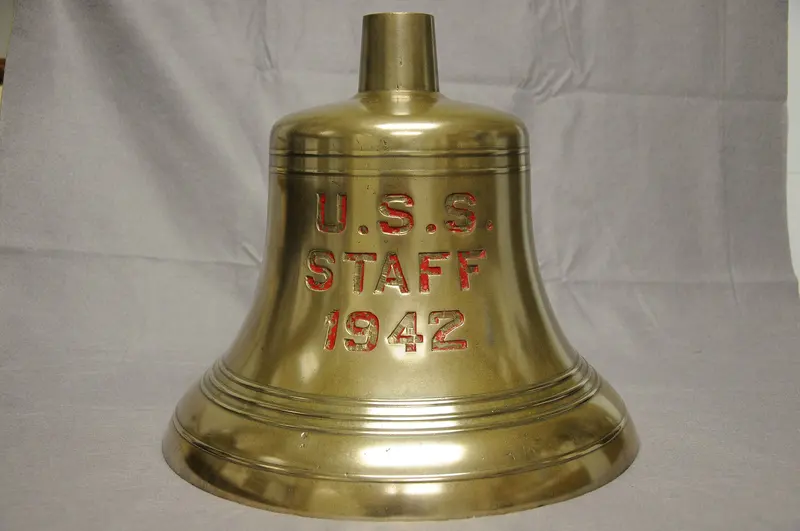
The bell had other jobs too. Royal Museums Greenwich says it sounded the alarm in fog or when someone went overboard, and in stormy weather it called all hands on deck. The Mary Rose Trust says its bell was used to warn other ships, especially in fog.
The Mary Rose bell
The oldest bell in this story was cast in 1510, the year the Mary Rose was commissioned. It is believed to have been cast in Flanders, and its inscription translates as "I was made in the year 1510". The ship sank in 1545, and the bell was one of the last objects recovered from beneath the wreck.
Sixteen bells for New Year
Here's the seasonal bit. The National Museum of the Royal New Zealand Navy says that, by naval tradition, the youngest member of the ship's company strikes the bell sixteen times at New Year: eight bells to ring out the old year, and eight to ring in the new.
The same museum describes another custom that began in the Royal Navy: babies christened on board, sometimes with the upturned bell used as the font, with the child's name engraved inside it afterwards.
A bell that came home
Bells can outlast their ships. Royal Navy Museums tells the story of the bell of HMS Hood, which sank in May 1941 during the engagement with the Bismarck; only three of the more than 1,400 men aboard survived. In 2015 an expedition recovered the bell from about 2,800 metres below the surface of the North Atlantic, and it is now on display at Royal Navy Museums in Portsmouth.
Ringing in 2027
You don't need a ship to borrow the tradition. If you're seeing in the New Year at home, sixteen strokes on anything that rings makes a good countdown, and the youngest person in the room gets the job.
And if you'll be out to celebrate, plan your way home first: our post on Christmas nights out near water has the fire and rescue services' advice.
Tipsy Anchor
Holding steady... ish.Available as: T-shirts, Hoodies, Mugs, Tote bags, Posters, Stickers