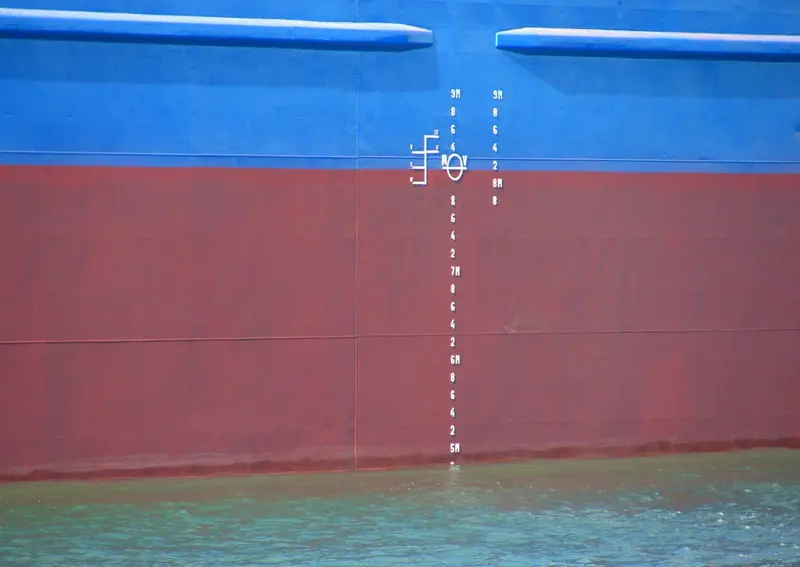
Next time you see a cargo ship in harbour, look along its side near the waterline. You may spot a circle with a horizontal line through it, and a ladder of short lines next to it. That's a load line, known in Britain as the Plimsoll line, and it's one of the most important safety marks at sea.
What it's for
Royal Museums Greenwich explains that a load line shows how deep a ship can safely be loaded. Put simply, the water should not rise above the line. If it does, the ship is overloaded and at greater risk of sinking.
The museum notes that the safe level isn't fixed: it varies with the temperature and saltiness of the water, the season and the part of the world, which is why a ship carries a set of marks rather than just one.
The problem: "coffin ships"
The idea is old. Royal Museums Greenwich says Venetian ships carried a cross on their hulls as early as the 12th century. But in the 1800s, as trade grew quickly, many ships were sent to sea overloaded and in poor condition. The museum says some became so unsafe they were known as "coffin ships", and that sailors who refused to sail in them could be imprisoned.
Lloyd's Register Foundation explains why: overloading increased profits, and it "resulted in the loss of thousands of lives and ships".
There were early attempts to fix it. In 1835 Lloyd's Register introduced a rule recommending three inches of freeboard (the height of the deck above the water) for every foot of the hold's depth. But it applied only to ships Lloyd's Register classed, and using it was optional.
Samuel and Eliza Plimsoll
Samuel Plimsoll (1824 to 1898) was a coal merchant from Bristol who became a Member of Parliament. Royal Museums Greenwich says he began investigating ship safety in 1870, and a Royal Commission on Unseaworthy Ships followed in 1872.
He didn't campaign alone. Lloyd's Register Foundation describes his wife, Eliza Plimsoll, as "an equal partner in the cause", whose contribution has often been overlooked.
The law
The campaign led to the Merchant Shipping Act 1876, which made load lines compulsory. It had a big weakness: Lloyd's Register Foundation says the Act left it to shipowners to paint the lines on themselves, and it was misused.
The sources differ on exactly when that loophole closed. Lloyd's Register Foundation and National Museums Liverpool say the Board of Trade standardised the load line in 1890; Royal Museums Greenwich says its position was fixed by law in 1894. Royal Museums Greenwich adds that from 1906 foreign ships visiting British ports had to carry one too. In Britain, the mark became known as the Plimsoll line.
Still needed
Overloading hasn't disappeared. Lloyd's Register Foundation notes that European and Canadian authorities reported 3,197 load line breaches as recently as 2005, and it works on ferry safety in countries where overloading remains a risk.
Plimsoll Day
National Museums Liverpool marks 10 February, Plimsoll's birthday, as Plimsoll Day, and its article on it is clear that it's "talking about ships, not shoes". Lloyd's Register Foundation marked the 200th anniversary of his birth in February 2024.
What's in the photo
The photo above shows the marks on a ship's hull: the circle with a line through it, and beside it a tall column of numbers painted on the side. The marks only work if they're painted in the right place and checked, which is exactly what Plimsoll's campaign was about.
Spotting one
You can see load lines on working ships in most big harbours, from a safe spot on the quayside. Look for the circle and line, and the letters and steps beside it. Our post on nautical phrases we still use has more sea words that made it ashore.

Tipsy Anchor
Holding steady... ish.Available as: T-shirts, Hoodies, Mugs, Tote bags, Posters, Stickers